
Kaal Sarp Puja Trimbakeshwar Cost: Complete 2026 Price Guide, Booking Steps & Everything You Need to Know
Every week, at least one family walks into our ashram near Kushavart Kund holding a printed horoscope and the same worried question: “Panditji, is this dosh real, and can it actually be fixed here?” Almost always, their second question follows immediately — “and what will it actually cost us?”
That second question is fair, and it’s also the one most Trimbakeshwar websites dance around. So before we get into the temple’s history or how each ritual works, let’s answer it directly: Kaal Sarp Puja in Trimbakeshwar typically costs anywhere from ₹501 for a basic group puja to ₹5,000 and above for an individual, fully customized ceremony — and where you land in that range depends on a few specific factors we’ll walk through below. If you’ve been quoted wildly different numbers by different pandits in this town, you’re not imagining it — and by the end of this guide, you’ll understand exactly why the range is so wide, and what you should actually be paying for your situation.
Kaal Sarp Puja Trimbakeshwar Cost: The Full Breakdown
This is the part most sites either skip entirely or bury under vague language like “affordable packages.” Here’s the real structure, based on how pujas are typically priced across Trimbakeshwar:
| Puja Type | Typical Cost Range | What Changes the Price |
|---|---|---|
| Kaal Sarp Dosh Puja (Group/Shared) | ₹501 – ₹1,500 | Performed alongside other devotees on the same day; shared samagri cost |
| Kaal Sarp Dosh Puja (Individual/Separate) | ₹2,100 – ₹5,000+ | Private Sankalp in your name only, dedicated time slot, full samagri |
| Rahu–Ketu Shanti Puja | ₹1,100 – ₹5,100 | Depends on chanting count (mantra repetitions) requested |
| Tripindi Shraddha | ₹2,500 – ₹5,000 | Number of ancestors/generations included |
| Narayan Nagbali Puja (3-Day) | ₹5,000 – ₹25,000+ | Most elaborate ritual — samagri, priest team, and 3-day duration drive cost up |
| Mahamrityunjay Jaap | ₹1,100 – ₹5,000+ | Based on 1.25 lakh vs. shorter mantra-count options |
Why the Kaal Sarp Puja Trimbakeshwar cost varies so much between ₹501 and ₹5,000+:
- Group vs. individual puja. A shared/group Kaal Sarp Puja (multiple families, same muhurat, same priest) is the ₹501–₹1,500 entry tier. An individual puja — your Sankalp alone, a dedicated time, full samagri reserved just for your family — moves into the ₹2,100–₹5,000+ range.
- Type of Kaal Sarp Dosh. Some of the twelve variations (like Anant Kaal Sarp Dosh or Sheshnag Kaal Sarp Dosh) are considered more intense and may call for additional havan offerings or a longer mantra count, which affects price.
- In-person vs. remote/online puja. If you can’t travel, we perform the puja here with your Sankalp taken in your name and stream it live — this generally costs the same as an in-person individual puja, since the ritual itself doesn’t change, only your attendance does.
- Samagri quality. Basic vs. premium ritual materials (flowers, fruits, ghee quantity, fire-ritual offerings) is usually where the ₹5,000+ tier comes from.
A word of caution on Kaal Sarp Puja Trimbakeshwar cost quotes: this town has a real reputation problem with pandits who quote a low number over the phone, then add “additional” charges once you’ve already traveled and are standing at the ashram. A trustworthy quote for your Kaal Sarp Puja Trimbakeshwar cost should be final before you book your train ticket — not renegotiated once you’ve arrived with no other option. We give you the full number after reviewing your kundali, in writing if you ask, with nothing added later.
Why Trimbakeshwar, Specifically
To understand why families pay this cost to travel here rather than performing a similar ritual closer to home, it helps to understand what makes this specific temple different.
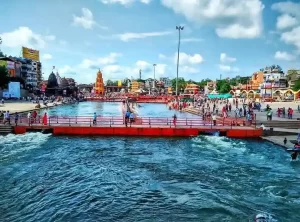
Trimbakeshwar is one of the twelve Jyotirlingas of Lord Shiva in India, but it’s the only one where the lingam itself has three small faces inside a single stone — representing Brahma, Vishnu, and Mahesh together. Local tradition traces this back to the sage Gautama Rishi, who is said to have performed years of penance at the base of Brahmagiri Hill during a severe famine, praying for the Godavari to flow again. Shiva is believed to have granted this, and the river’s traditional source point — Kushavarta Kund, right inside the temple complex — is where pilgrims still take a purifying dip before any ritual.
The stone structure you see today isn’t ancient in the way people assume. It was commissioned in the 1700s by Peshwa Balaji Baji Rao (Nanasaheb) after earlier structures were damaged during Mughal-era conflict, and it’s built from black basalt in the old Hemadpanthi style — thick walls, deep carving, built to outlast centuries.
Here’s something most guides skip: Trimbakeshwar is one of five Jyotirlingas located within Maharashtra alone (the others are Bhimashankar, Ghrishneshwar, Vaijnath, and Aundha Nagnath), but it’s the only one of the five where Kaal Sarp Dosh, Narayan Nagbali, and Tripindi Shraddha are traditionally performed at all — which is exactly why this specific town, more than any other pilgrimage site in India, has become the center for these remedies, and why the Kaal Sarp Puja Trimbakeshwar cost conversation only really applies here.
The History Behind Kaal Sarp Dosh and Trimbakeshwar’s Role in It
Kaal Sarp Dosh isn’t a modern invention grafted onto astrology — its roots trace back to the Puranic account of Samudra Manthan, the churning of the cosmic ocean, where the demon Swarbhanu secretly drank a drop of the nectar of immortality and was severed in two by Vishnu’s discus. The head became Rahu, the tail became Ketu, and together they were condemned to eternally chase the sun and moon across the sky. Ancient astrologers came to associate a chart where every planet sits trapped between these two shadow points with prolonged obstruction in life, and remedies for this “serpent dosh” were traditionally entrusted only to sites already tied to serpent worship and the origin of a sacred river — which is exactly what Trimbakeshwar has represented for centuries, sitting as it does at the birthplace of the Godavari.
Because the Tamrapatradhari priest families here have carried the exact Sankalp wording, mantra sequence, and havan procedure across generations, rather than this being something performed at any ordinary Shiva temple, Trimbakeshwar gradually became the recognized center where families travel specifically to address this dosh. This is really where today’s Kaal Sarp Puja Trimbakeshwar cost conversation begins: the Kaal Sarp Puja Trimbakeshwar cost you’re quoted today reflects centuries of this being a hereditary, specialized ritual rather than a generic temple offering, and understanding that history explains why the Kaal Sarp Puja Trimbakeshwar cost here can look different from a similar-sounding puja performed elsewhere. Even the wide range in Kaal Sarp Puja Trimbakeshwar cost you’ll see across different pandits in town traces back to this same lineage system — some priest families are more sought-after than others precisely because of how long their line has performed this specific remedy, and that reputation is often reflected in what they charge.
Visiting the Temple: What to Actually Expect
If you’re planning to combine your puja with a temple visit, a few practical things matter more than the mythology.
Timings. General darshan typically runs from around 5:30 AM to 9:00 PM, though this shifts on festival days. Mornings, especially before 7:00 AM, are calmer — by mid-morning on a Monday or during Shravan month, the queue can stretch for hours.
Crowd patterns. Mondays are the busiest ordinary day, because the temple’s golden crown — normally kept locked away — is displayed and carried in a short procession to Kushavarta Kund in the late afternoon. If you want a quiet darshan, avoid Mondays, Amavasya, and obviously Mahashivratri, when the town effectively doesn’t sleep.
Darshan options. General darshan is free; devotees view the lingam from roughly five meters away. A paid VIP/faster-entry pass exists for those short on time, though it doesn’t change what you see — just how long you wait.
Photography. Not permitted inside the sanctum. This surprises a lot of first-time visitors who expect to record the ritual.
Getting here. The nearest railway station is Nashik Road, about 30 km away. The nearest airport is Ozar (Nashik), roughly 30–40 km out — though most pilgrims from outside Maharashtra actually fly into Mumbai and drive down, which is a longer trip (180–200 km, around 4–5 hours depending on traffic) but far more common given flight frequency.
One thing visitors often ask us about is the absence of a large bell at the main entrance, unlike most Shiva temples. There isn’t a single settled explanation — different local accounts give different reasons, and honestly, I’d rather tell a family “we’re not certain” than repeat a story I can’t stand behind. It’s one of those small mysteries that makes the temple feel older than its written history.
The Four Pujas We Perform — What Actually Happens
This is the part most websites get vague about, so let me walk through each one the way I’d explain it in person, including what drives its cost.
1. Kaal Sarp Dosh Puja
This is the ritual people ask about most, and the biggest factor in most Kaal Sarp Puja Trimbakeshwar cost questions. Kaal Sarp Dosh forms when, in your birth chart, all seven classical planets sit between Rahu and Ketu — not a curse, just a specific geometric pattern in the horoscope that Vedic astrology associates with delay and obstruction rather than outright misfortune.
There are twelve variations depending on which house Rahu and Ketu occupy — Vasuki, Kulik, Shankhachood, Vishdhar, Ghatak, and others — and the remedy differs slightly by type, but the core structure, and therefore the base cost, is similar:
- Sankalp (a formal declaration using your name, gotra, and intention)
- Ganesh Puja to clear obstacles before the main ritual begins
- Navagraha Puja — worship of the nine planetary deities
- Rahu–Ketu mantra chanting, often in multiples of 108, sometimes running into thousands of repetitions depending on severity
- Havan (fire ritual) with specific offerings for Rahu and Ketu
- Rudrabhishek to close the ceremony
The full puja typically takes 3 to 4 hours and is best performed on Amavasya, Nag Panchami, or a Monday — check our Kaal Sarp Puja dates for 2026 for the full auspicious calendar.
The honest part: not everyone who thinks they have Kaal Sarp Dosh actually has it in a form that needs remedy. Before booking, we check the actual chart. If the placement is minor or the effects described don’t line up with the birth details, I’ll say so — even if it means turning away a booking and its cost.
You can see the full ritual breakdown on our Kaal Sarp Dosh Puja page.
2. Pitru Dosh Puja (including Narayan Nagbali & Tripindi Shraddha)
Pitru Dosh is believed to arise from unresolved obligations to ancestors — rites not performed, a death that occurred suddenly or away from home, or inherited karmic imbalance. It tends to show up in a family’s life as recurring financial strain, delays in marriage or childbirth, or a home that never quite feels settled.
For milder cases, we perform Tripindi Shraddha — a single-day ritual involving pind daan (symbolic offerings) and tarpan (water offerings) to the ancestors.
For more serious or long-standing cases, the full Narayan Nagbali Puja is recommended — a three-day ritual performed only by Tamrapatradhari-authorized priests, structured as:
- Day 1: Narayan Bali, addressing ancestors who passed without proper rites
- Day 2: Nag Bali, using a symbolic wheat-flour serpent to atone for harm to a snake (real or karmic)
- Day 3: Pind Daan and Tarpan to formally release and honor the ancestral souls
This is the longest and most involved ritual we perform, which is why its cost sits at the top of the range — it requires a full-day fast beforehand and a three-day priest commitment. Full details are on our Pitru Dosh Puja page.
3. Mahamrityunjay Jaap
Simpler in structure but no less significant — this is the chanting of the Mahamrityunjaya mantra (the “Om Tryambakam” verse), traditionally performed for health, protection, and longevity, either for oneself or on behalf of someone unwell. It’s usually done in counts of 1.25 lakh (125,000) repetitions for a complete jaap, though shorter versions exist, combined with Shiva Abhishekam. See our Mahamrityunjay Puja page for the mantra-count options and matching cost tiers.
4. Rahu–Ketu Shanti Puja
A more focused version of planetary pacification for people experiencing career stagnation, anxiety, or relationship friction tied to a Rahu or Ketu dasha (planetary period) rather than a full Kaal Sarp formation. It includes Navagraha worship and a havan with Rahu–Ketu beej mantras — generally a shorter, more affordable ritual than the full Kaal Sarp Puja Trimbakeshwar cost tier. Details on our Rahu-Ketu Shanti Puja page.
What People Actually Search — and What They’re Really Worried About
Looking at what people ask us and what they type into Google before calling, most questions underneath the search terms come back to trust and cost, not ritual detail:
- “Kaal Sarp Puja Trimbakeshwar cost” — By far the most searched phrase, and the least consistently answered one online, which is exactly why we’ve broken it down above rather than saying “contact us for pricing.”
- “Is Kaal Sarp Dosh real or a scam?” — People aren’t just asking about astrology; they’ve usually read about pandits pressuring devotees into expensive, unnecessary pujas.
- “How do I know a Trimbakeshwar pandit is genuine?” — Look for Tamrapatradhari authorization (a copper-plate credential recognized by the Trimbakeshwar Purohit Sangh). Legitimate priests won’t hesitate to show this.
- “Can I do this puja without traveling to Trimbakeshwar?” — Yes, for most of these rituals we perform the ceremony here with your Sankalp taken in your name and stream it live, so distance isn’t a barrier, and the cost stays the same as an in-person individual puja.
- “Will I be asked to pay more once I arrive?” — This is the single biggest fear we hear, and it’s a fair one given how common it is in this town. A trustworthy pandit gives you a clear Kaal Sarp Puja Trimbakeshwar cost breakdown before you travel, not after.
How to Book With Us
- Call or WhatsApp Acharya Anand Shastri Ji directly at +91 98225 53874, or email anandshastritrimbakeshwar@gmail.com.
- Share your birth details (date, time, place of birth) for a free kundali review — this is where we tell you honestly whether you need a puja, which one, and what your specific Kaal Sarp Puja Trimbakeshwar cost will be based on your situation.
- Choose your date, ideally around an auspicious muhurat we’ll help identify, and confirm attendance — in person or remote.
- The puja is performed at our location near Kusha Vartha Kund Tirth Kshetra, Trimbakeshwar Mandir, Nashik, with live video for those joining remotely.
- You receive photos, videos, and prasad, shipped to your address if you weren’t able to attend in person.
You can also start directly from our puja booking page or read more about our background before reaching out.
Final Thought
Trimbakeshwar isn’t just a stop on a pilgrimage circuit — for the families we’ve worked with over the past 25 years, it’s usually the place they come to after trying everything else. Our job isn’t to convince you that you need a ritual, or to make the Kaal Sarp Puja Trimbakeshwar cost conversation confusing. It’s to look honestly at your chart, tell you what it actually shows, quote you a single honest number for your situation, and if a puja is warranted, perform it the way it’s meant to be done — properly, transparently, and without the games some parts of this town have become known for.
If you’re unsure where to start, call and ask us your chart and cost questions before booking anything. That conversation costs nothing.