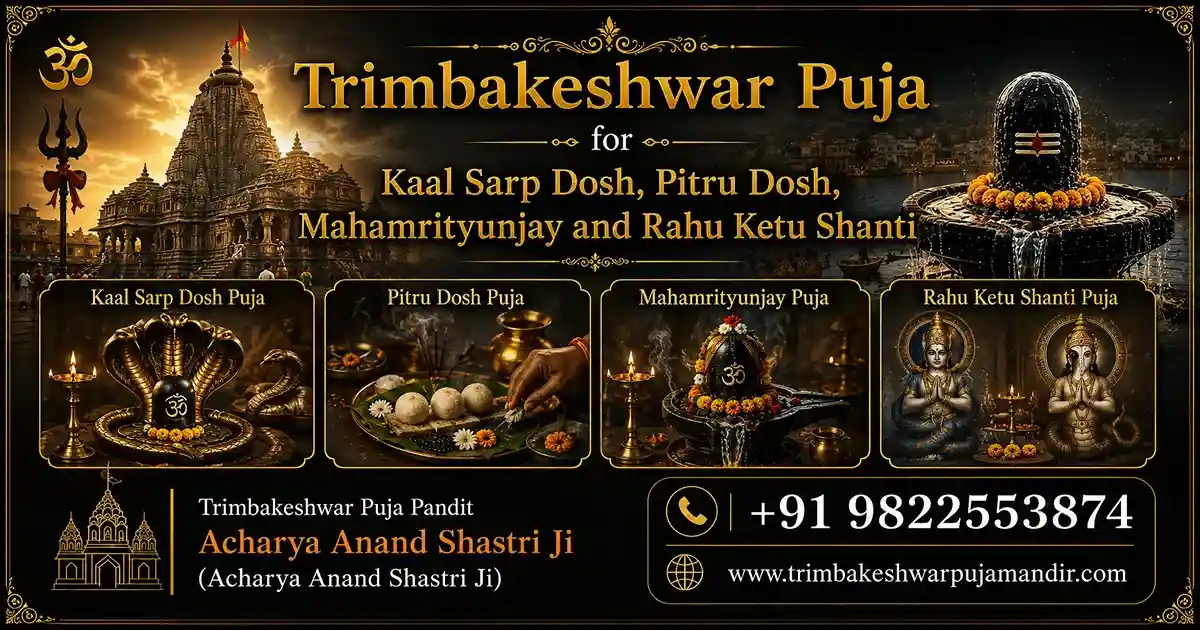
Trimbakeshwar Pooja for Kaal Sarp Dosh, Pitru Dosh, Mahamrityunjay and Rahu Ketu Shanti: The Complete Devotee’s Guide
A first-hand style guide to the four rituals devotees ask about most before they book a Trimbakeshwar pooja where each ritual comes from, why Trimbakeshwar is chosen over any other Shiva kshetra for it, and exactly what happens once you sit down in front of the priest.
Introduction: Why This Guide Exists
Every week, hundreds of families search for a Trimbakeshwar Kaal Sarp Puja sometimes spelled Trimbakeshwar Kaal Sarp Pooja — without knowing whether that is even the right ritual for them. Someone tells them their kundali has a “snake curse.” An astrologer mentions their ancestors are “unhappy.” A relative insists they need a “mahamrityunjay jaap” for health, and somebody else swears by “rahu ketu shanti” for a stalled marriage proposal. By the time they reach Nashik, most devotees are carrying four different opinions and one confused mind.
This guide is written to solve exactly that confusion. Instead of treating Trimbakeshwar pooja for Kaal Sarp Pooja, Pitru Dosh pooja, Mahamrityunjay pooja, and Rahu Ketu Shanti pooja as four unrelated services, we are placing them side by side — their history, their scriptural roots, the specific reason Trimbakeshwar Jyotirlinga is considered the right kshetra for each one, and the actual ritual sequence a purohit follows when you sit for the sankalp. If you read only one page before your visit, this is the one meant to remove the guesswork, not add to it.
Trimbakeshwar sits at the base of Brahmagiri hill, where the Godavari river is believed to originate, roughly thirty kilometres from Nashik city in Maharashtra. It is one of the twelve Jyotirlingas associated with Lord Shiva, and unlike most Shiva shrines, the lingam here is worshipped as a triad — representing Brahma, Vishnu, and Mahesh together. That triple association is the reason this particular temple town became, over centuries, the preferred site for rituals connected to karma, ancestry, planetary affliction, and life protection — the four themes this article covers.
A Short History: How These Four Rituals Found a Home in Trimbakeshwar
Long before “dosh nivaran packages” existed, Trimbakeshwar was already a pilgrimage centre built around penance. The Skanda Purana and the Padma Purana both describe Sage Gautam performing tapasya on Brahmagiri hill to atone for an unintended act of cow-slaughter. Pleased with his austerity, Lord Shiva is said to have released the Godavari from the hill and agreed to stay behind in Trimbakeshwar as the Jyotirlinga itself. This origin story matters because it set the template for everything that followed: Trimbakeshwar became, in the popular imagination, the place where a person could go to undo an unintended wrong — exactly the function that Trimbakeshwar Kaal Sarp Puja, Pitru Dosh puja, and Rahu Ketu Shanti puja are believed to serve today.
The Mahamrityunjay mantra has a separate and older lineage. It appears in the Rig Veda (Mandala VII) and again in the Yajur Veda, addressed to Shiva as Tryambaka — “the three-eyed one.” Tryambaka is not a generic epithet; scholars and local priests both point out that it is the same root as “Trimbak,” the name of this very town. When the mantra is chanted at Trimbakeshwar, priests here will tell you it is being offered to the deity it was written for, in the place that carries his name. That linguistic and mythological overlap is a large part of why Mahamrityunjay jaap performed at Trimbakeshwar carries more weight for devotees than a jaap performed at home.
Pitru Dosh remedies — Narayan Nagbali, Tripindi Shraddha, and Pind Daan — became associated with Trimbakeshwar for a more practical reason. Kushavarta Kund, the sacred tank a short walk from the main temple, is treated as the symbolic source of the Godavari, and river-source points have always held special status in Hindu funerary tradition for ancestor worship, similar to how Gaya on the Falgu river is used for Pind Daan in North India. Trimbakeshwar effectively became the Deccan’s own version of that tradition — the place families travelled to when ordinary shraddha karma at home did not seem to be enough.
Trimbakeshwar pooja Kaal Sarp and Rahu Ketu remedies arrived at Trimbakeshwar somewhat later, largely through the growth of Vedic astrology (jyotish shastra) as a parallel tradition practised alongside temple ritual in Maharashtra from roughly the medieval period onward. Because Rahu and Ketu are shadow points without a physical form of their own in the sky, classical astrology treats them as needing appeasement through a deity strong enough to “hold” serpent energy — and Shiva, who is depicted wearing a serpent (Vasuki) around his neck in nearly every classical image, became the natural choice. A Jyotirlinga where Shiva himself is already worshipped as lord of destiny made Trimbakeshwar a logical, and eventually the most sought-after, address for this particular remedy.
Put together, none of these four rituals arrived at Trimbakeshwar by marketing. Each has an independent scriptural or mythological reason for being performed here, and that history is exactly what separates a Trimbakeshwar puja from the same ritual performed at a local temple back home.
1. Trimbakeshwar Pooja (Trimbakeshwar Kaal Sarp Pooja): Meaning, Origin, and How It Is Performed
What Kaal Sarp Dosh Actually Means
In a birth chart, when every planet — Sun, Moon, Mercury, Venus, Mars, Jupiter, and Saturn — falls within the arc between Rahu and Ketu, classical jyotish calls this Kaal Sarp Yog. Depending on which house Rahu occupies, astrologers classify it into twelve named types (Anant, Kulik, Vasuki, Shankhpal, Padma, Mahapadma, Takshak, Karkotak, Shankhachood, Ghatak, Vishdhar, and Sheshnag). This is not a rare curse reserved for the unlucky few — many charts show a partial or complete version of it — but traditional astrologers do treat a strong Kaal Sarp Dosh as capable of slowing career growth, delaying marriage, disturbing sleep and mental peace, and creating a repeated sense of “nothing moving forward despite effort.” If your own chart shows this affliction, our dedicated Kaal Sarp Dosh Puja page covers booking, pricing, and priest availability in detail.
Why This Trimbakeshwar Kaal Sarp Puja Exists in the First Place
The remedy logic is straightforward within the tradition: Rahu and Ketu are treated as serpent-headed and serpent-tailed shadow grahas, and Shiva — shown wearing a live serpent as an ornament — is considered the one deity who has already tamed that same energy. A Trimbakeshwar Kaal Sarp Puja — or Trimbakeshwar Kaal Sarp Pooja, as many devotees spell and search for it — is, in effect, asking the deity who controls the serpent to loosen its grip on your chart.
How the Ritual Unfolds at Trimbakeshwar
A typical Trimbakeshwar Kaal Sarp Puja (or Trimbakeshwar Kaal Sarp Pooja, whichever spelling you’re used to) begins the same way almost every major ritual here does — with a sankalp, where the priest states your name, gotra, and the specific intention of the puja aloud. This is followed by a Ganesh puja to clear obstacles before the main ritual starts. The priest then leads Rahu-Ketu mantra japa, usually a fixed count agreed upon in advance, along with offerings of milk, black til (sesame), and flowers poured over a silver or brass serpent idol representing Rahu and Ketu together. Some priests conclude with a short havan. The entire sequence, from sankalp to final aarti, generally takes two to three hours, and most families are advised to bathe in Kushavarta Kund before the ritual begins, as purification before any Trimbakeshwar puja is treated as non-negotiable by local purohits.
2. Trimbakeshwar Pooja for Pitru Dosh: Meaning, Origin, and How It Is Performed
What Pitru Dosh Actually Means
Pitru Dosh is described in classical astrology as arising when the placement of the Sun, Rahu, Saturn, or the ninth house in a horoscope indicates unresolved obligation toward one’s ancestors — often because a forefather died an untimely or unnatural death, or because customary shraddha rites were skipped, delayed, or performed incorrectly. In lived practice, families rarely arrive with a chart reading in hand; they arrive because of a pattern repeated miscarriages, an unusual delay in a daughter or son’s marriage, chronic illness that doctors cannot explain, or a general sense that “nothing settles” in the household no matter what is done.
Why Trimbakeshwar Is Chosen for Pitru Dosh Remedies
Ancestor-worship rituals in Hindu tradition are almost always tied to a specific tirtha associated with a sacred river. Just as Gaya is linked to the Falgu river in the north, Trimbakeshwar is linked to the Godavari, whose symbolic origin point, Kushavarta Kund, sits inside the temple complex itself. A Pitru Dosh Trimbakeshwar pooja is therefore performed with the same river-source logic that has guided ancestor rites across India for centuries — the belief that offerings made at the point where a sacred river begins reach further than offerings made downstream. Families who also plan a Trimbakeshwar Kaal Sarp Puja on the same trip are usually advised to complete the ancestor rites first.
How the Ritual Unfolds at Trimbakeshwar
Depending on the family’s specific situation, the priest may recommend a shorter Pitru Dosh Nivaran puja (roughly three to four hours) or the more elaborate Narayan Nagbali — a ritual stretched across a full day or, in some cases, three days, combining Narayan Bali and Nagbali with a final Ganesh puja. The core elements remain consistent: a holy dip at Kushavarta Kund, Pind Daan (offering of rice balls representing three generations of ancestors), Tarpan (pouring of water with sesame seeds while invoking ancestors by name and gotra), and closing mantras dedicated to both Vishnu and Shiva. Priests generally advise performing this puja during Pitru Paksha, on an Amavasya, or during the Hindu months of Magh, Falgun, or Kartik, though it can technically be performed on most days the temple permits ritual bookings. Full booking details and package options are listed on our Pitru Dosh Puja page.
3. Trimbakeshwar Pooja for Mahamrityunjay: Meaning, Origin, and How It Is Performed
What Mahamrityunjay Actually Means
The Mahamrityunjay mantra — “Om Tryambakam Yajamahe Sugandhim Pushtivardhanam, Urvarukamiva Bandhanan Mrityor Mukshiya Mamritat” — is one of the oldest surviving Sanskrit verses still in daily ritual use, appearing in both the Rig Veda and the Yajur Veda. It is a prayer to Shiva as Tryambaka (three-eyed one), asking for release from disease, fear, and untimely death, in the same way a ripe cucumber falls naturally from its vine rather than being torn away.
Why This Trimbakeshwar Pooja Feels Different Here
Local priests are quick to point out something devotees rarely notice elsewhere: the word “Tryambaka” in the mantra and the name “Trimbak” (from which Trimbakeshwar gets its name) share the same root. Reciting the Mahamrityunjay mantra at Trimbakeshwar is, quite literally, addressing the deity by the name of the town he is enshrined in. This is why a Mahamrityunjay jaap booked as part of a Trimbakeshwar pooja is treated by pandits as carrying extra resonance compared to the same jaap chanted elsewhere — the geography and the mantra point to the same deity.
How the Ritual Unfolds at Trimbakeshwar
Families typically book this puja for a specific number of repetitions — common counts include 11,000, 1,25,000 (sava lakh), or higher, depending on budget and the priest’s guidance. The priest and any assisting purohits chant the mantra in rounds while the yajaman (the person on whose behalf the puja is performed) sits facing the Shivalinga or a home-style setup arranged for the ritual, with bilva leaves, water, and flowers offered at intervals. A short Rudrabhishek — bathing the lingam with milk, honey, curd, ghee, and sugarcane juice — is frequently combined with the jaap, since both rituals are addressed to the same form of Shiva. Most sittings run one to two hours for a standard count, extending across a full day or more for the higher mantra counts. Devotees who have already booked a Trimbakeshwar Kaal Sarp Puja often add this jaap on the same day, since the Rudrabhishek offerings overlap. Mantra-count options and pricing are listed on our Mahamrityunjay Puja page.
4. Trimbakeshwar Pooja for Rahu Ketu Shanti: Meaning, Origin, and How It Is Performed
What Rahu Ketu Shanti Actually Means
Rahu and Ketu are not physical planets but mathematical points — the north and south lunar nodes, marking where the moon’s orbit crosses the sun’s apparent path. Vedic astrology treats them as shadow grahas capable of producing sudden, unpredictable disruption: unexplained anxiety, obsessive thinking, sudden reversals in career or finance, and confusion around decisions that should otherwise be straightforward. A Rahu Ketu Shanti puja is recommended specifically when these two points sit poorly in a chart — whether or not the person also has full Kaal Sarp Dosh.
Why Trimbakeshwar Is the Preferred Site for This Puja
Because Rahu and Ketu are depicted as serpent-headed and serpent-tailed forces, and Shiva is the deity most closely tied to serpent imagery in the entire Hindu pantheon, a Rahu Ketu Trimbakeshwar puja follows the same underlying logic as a Trimbakeshwar Kaal Sarp Puja — approaching the one deity iconographically associated with mastering the serpent — but is typically recommended as a lighter, more targeted ritual when a person’s affliction is specifically nodal rather than a full-chart Kaal Sarp formation.
How the Ritual Unfolds at Trimbakeshwar
The priest begins with sankalp and a brief Ganesh puja, followed by japa of the Rahu-Ketu beej mantra, offerings of blue or black flowers, coconut, and mustard oil (items traditionally associated with these two grahas), and a closing prayer to Shiva. Some purohits combine this with a Naga (serpent) puja involving a small silver or gold snake idol donated as part of the ritual. Depending on the mantra count chosen, the sitting usually lasts one and a half to three hours. See our Rahu-Ketu Shanti Puja page for exact offerings and booking slots.
Can a Trimbakeshwar Kaal Sarp Puja Be Combined With the Other Three?
This is the single most common question families ask once they understand the four rituals individually — and the honest answer is: yes, frequently, but not carelessly. Purohits in Trimbakeshwar routinely combine two or more of these rituals into a single trip when a devotee’s chart or family situation genuinely calls for it. A commonly recommended sequence looks like this:
- Holy bath at Kushavarta Kund — performed before any of the four rituals, regardless of combination.
- Ganesh puja and sankalp — a shared opening for whichever combination is chosen that day.
- Pitru Dosh rites first, if applicable — ancestor-related rituals are traditionally completed before planetary remedies, since unresolved ancestral debt is believed to interfere with the effectiveness of later prayers.
- Trimbakeshwar Kaal Sarp Puja or Rahu Ketu Shanti puja next — rarely both in full on the same day unless the family has more than one day available, since each involves a distinct mantra count and offering set.
- Mahamrityunjay jaap and Rudrabhishek to close — treated as a general blessing and protection layer that fits naturally at the end of any combination.
A family travelling from outside Maharashtra will often plan two to three days in Trimbakeshwar specifically to accommodate this sequence without rushing any single ritual — rushing is something every priest here will actively discourage, since the sankalp and mantra count are considered meaningless if hurried.
Best Time to Book a Trimbakeshwar Pooja
While purohits in Trimbakeshwar conduct rituals through most of the year, certain windows are considered more favourable for specific pujas. Check our Puja Dates page for the current calendar before you plan your trip:
- Shravan month (July–August) — widely considered auspicious for any Shiva-centred ritual, including Mahamrityunjay jaap and Rudrabhishek.
- Mahashivratri — the single most crowded and most spiritually significant day at the temple, suited to all four rituals.
- Nag Panchami and the month of Sawan — specifically favoured for Trimbakeshwar Kaal Sarp Puja and Rahu Ketu Shanti puja.
- Pitru Paksha, Amavasya dates, and the months of Magh, Falgun, and Kartik — traditionally recommended for Pitru Dosh Nivaran and Narayan Nagbali.
- Mondays — considered generally auspicious for Shiva worship and often chosen for shorter rituals like Rudrabhishek.
Early morning slots are preferred across all four rituals, both because temple crowds are thinner and because tradition holds that the mind is calmest and most receptive shortly after sunrise.
What to Carry and How to Prepare
Devotees planning any of these four rituals are generally advised to:
- Confirm full names and gotra of family members in advance, since the sankalp requires this information to be stated correctly.
- Carry any horoscope or kundali documentation if available, particularly for a Trimbakeshwar Kaal Sarp Puja or Rahu Ketu Shanti puja, so the priest can confirm the specific dosha type.
- Wear simple, traditional clothing — priests generally ask for modest attire suited to temple rituals rather than western wear.
- Keep the day free of other engagements; even the shorter rituals can extend beyond their estimated time if the temple is crowded.
- Observe a light diet or a short fast the day before, which many purohits recommend though it is not strictly compulsory.
Approximate Duration and Cost Overview
Costs and duration vary by priest, number of participants, and the specific items included, but as a general guide:
| Puja | Typical Duration |
|---|---|
| Trimbakeshwar Kaal Sarp Puja | 2–3 hours |
| Rahu Ketu Shanti Puja | 1.5–3 hours |
| Mahamrityunjay Jaap | 1–2 hours (longer for higher mantra counts) |
| Pitru Dosh Nivaran Puja | 3–4 hours |
| Narayan Nagbali (extended Pitru Dosh remedy) | 1–3 days |
Families are always encouraged to confirm exact inclusions — items, mantra count, and priest fees — directly before booking, since packages differ from one purohit to another.
Frequently Asked Questions
Is it necessary to perform all four pujas together?
No. Very few families need all four at once. A knowledgeable purohit will usually ask about your specific concern — health, career delay, marriage delay, or a general sense of family disturbance — before recommending which one or two rituals actually apply to your situation.
Can a Trimbakeshwar pooja be performed without travelling to Nashik?
Some purohits offer a remote arrangement where the ritual is conducted at the temple on your behalf while you participate by phone or video from home. Most priests, however, note that being physically present for the sankalp is considered more complete, particularly for Pitru Dosh and Trimbakeshwar Kaal Sarp Puja remedies.
Is Trimbakeshwar Pooja spelled “Puja” or “Pooja” — does it matter which I search for?
Both spellings refer to the same ritual; “puja” and “pooja” are simply transliteration variants of the same Sanskrit word, and Trimbakeshwar priests use both interchangeably when devotees ask about Trimbakeshwar Pooja bookings for any of these four rituals.
How do I know whether I need a Trimbakeshwar Kaal Sarp Puja or simply an afflicted Rahu-Ketu placement remedy?
This distinction genuinely requires a horoscope reading. Carrying your birth details — date, time, and place of birth — to Trimbakeshwar allows the priest or an accompanying astrologer to check your chart before recommending a full Trimbakeshwar Kaal Sarp Puja versus the lighter Rahu Ketu Shanti puja.
Does the Mahamrityunjay jaap need to be repeated periodically?
Many devotees choose to repeat a shorter Mahamrityunjay jaap annually or during periods of illness, though a single well-performed sitting is traditionally considered sufficient for its stated purpose of protection and longevity.
What is the difference between Pitru Dosh Nivaran puja and Narayan Nagbali?
Pitru Dosh Nivaran is the shorter, more commonly performed ritual for general ancestral discomfort. Narayan Nagbali is a longer, more elaborate rite specifically recommended when a family history includes an unnatural or untimely death, or when simpler remedies have not brought relief.
Can these rituals be performed on behalf of a person who cannot travel?
Yes. The sankalp allows a family member to perform the puja on behalf of someone unwell, elderly, or unable to travel, as long as their name and gotra are correctly stated to the priest.
How far in advance should I book a Trimbakeshwar Kaal Sarp Puja?
During peak windows like Shravan, Mahashivratri, and Nag Panchami, it’s best to book your Trimbakeshwar Kaal Sarp Puja at least one to two weeks ahead, since priest availability and preferred time slots fill up quickly during these periods. Outside peak season, a few days’ notice is usually enough.
Closing Thoughts
Trimbakeshwar Kaal Sarp Puja, Pitru Dosh, Mahamrityunjay, and Rahu Ketu Shanti are four separate traditions with four separate histories, yet all four found a natural home in the same small temple town for reasons rooted in scripture rather than convenience a Jyotirlinga worshipped as Brahma, Vishnu, and Mahesh together; a river believed to originate at its doorstep; and a mantra written for a deity whose name the town still carries. Whether you’re planning a Trimbakeshwar Kaal Sarp Puja or one of the other three rituals, understanding the history behind it — not just the ritual itself — tends to make the experience mean considerably more once you are actually standing at Kushavarta Kund with the priest beginning your sankalp.
If you are still unsure which of these four rituals fits your situation, the simplest next step is a short conversation with a purohit before you travel — most are willing to review your concern, and your horoscope if you have one, and tell you honestly which Trimbakeshwar puja applies to you rather than selling you all four. You can contact us directly to check dates and get a straight recommendation before booking.