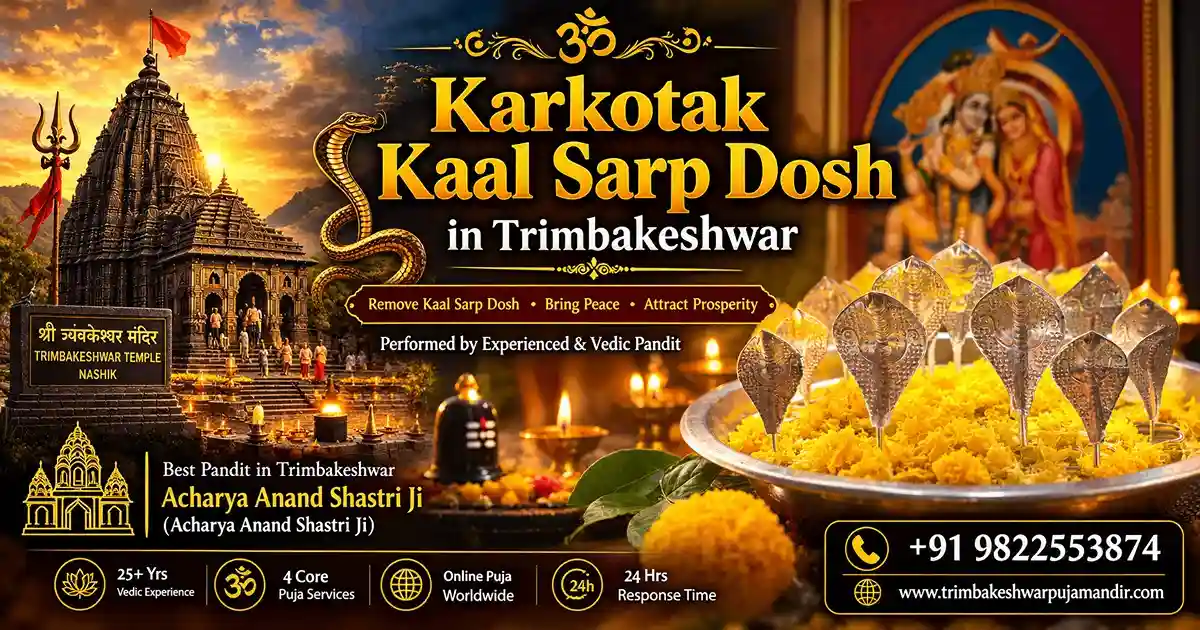
Karkotak Kaal Sarp Dosh Trimbakeshwar: What It Really Means for Your Family and Wealth
If someone has recently told you that you have Karkotak Kaal Sarp Dosh, your first reaction was probably a mix of worry and confusion. That’s normal. Most people who come to us at Trimbakeshwar with this specific dosh don’t fully understand what it means — they just know an astrologer mentioned “Karkotak” and it sounded serious. So let’s slow down and actually explain Karkotak Kaal Sarp Dosh Trimbakeshwar remedies the way we would if you were sitting across from us at the temple.
Karkotak Kaal Sarp Dosh is the eighth of the twelve recognized Kaal Sarp Yogs. It forms when Rahu occupies the 8th house of your birth chart and Ketu sits directly opposite in the 2nd house, with all the other planets trapped between them. In Vedic astrology, the 8th house governs sudden events, hidden matters, transformation, and — yes — mortality-related fears. The 2nd house governs family wealth, savings, speech, and the values passed down through your household. When Rahu and Ketu occupy exactly these two houses, the shadow planets end up influencing both what you build financially and how safe your family feels while building it.
That combination is why Karkotak tends to show up in people’s lives as a specific, recognizable pattern rather than vague bad luck — and why families specifically search for Karkotak Kaal Sarp Dosh Trimbakeshwar remedies rather than a generic fix.
How Karkotak Kaal Sarp Dosh Actually Shows Up in Real Life
We’ve sat with hundreds of families who came to Trimbakeshwar carrying this dosh, and the pattern repeats itself more often than you’d expect. It’s rarely one big dramatic event. It’s usually a slow accumulation of smaller frustrations that, taken together, start to feel like something deeper is going on.
Here’s what people commonly describe:
- Money that never quite settles. Income comes in, but it leaves just as fast — through unexpected repairs, medical bills, family obligations, or investments that quietly underperform. It’s not poverty; it’s instability. You earn, but you don’t accumulate the way your effort should allow.
- A nagging sense of insecurity around family wealth. Ancestral property disputes, unclear inheritance, or a general feeling that family savings are “cursed” to disappear — this comes up again and again with Karkotak natives. If ancestral matters feel especially heavy in your case, it’s worth also checking whether Pitru Dosh is present alongside Karkotak, since the two often overlap.
- Health scares that come suddenly, not gradually. Because the 8th house rules sudden events, people with this dosh often report health issues that appear out of nowhere rather than building over time.
- Difficulty trusting people close to the family. The 8th house also touches on secrets and hidden dealings, so many Karkotak natives describe a pattern of being let down by people they trusted with money or family matters.
- A quiet fear of mortality that shows up as anxiety. This is one families rarely say out loud at first, but with some gentle conversation, it comes up almost every time.
If two or three of these sound familiar, it doesn’t mean your life is doomed — it means the planetary placement is doing what it does, and there’s a well-established remedy for exactly this pattern through Karkotak Kaal Sarp Dosh Trimbakeshwar puja.
Why This Dosh Specifically Points People Toward Trimbakeshwar
You might be wondering why so many pandits, including us, specifically recommend Trimbakeshwar for Kaal Sarp doshas rather than any other Shiva temple. There’s a real reason, not just tradition for tradition’s sake.
Trimbakeshwar is one of the twelve Jyotirlingas, and it holds a very particular place in Vedic tradition as the site where Rahu and Ketu themselves are believed to have sought forgiveness from Lord Shiva. The temple sits at the source of the Godavari River, at the base of the Brahmagiri hills, and Narayan Nagbali and Kaal Sarp Dosh pujas are performed here in a way that’s authorized nowhere else in quite the same lineage. When you’re dealing with a dosh rooted in Rahu-Ketu placement — like Karkotak — performing the remedy at the one place traditionally associated with pacifying these two shadow planets carries a weight that a generic ritual elsewhere simply doesn’t.
We’re not saying this to be dramatic. We’re saying it because when families ask us “does location actually matter for Karkotak Kaal Sarp Dosh,” the honest answer, rooted in the tradition we were trained in at Trimbakeshwar, is yes — especially for this category of dosh.
What the Karkotak Kaal Sarp Dosh Trimbakeshwar Puja Actually Involves
People often expect the puja to be complicated or mysterious. It isn’t complicated, but it is precise, and every step exists for a reason.
Sankalp (the intention-setting). Before anything else happens, we take a sankalp in your name, your gotra, and your specific birth details. This is where your intention — removing the effects of Karkotak Kaal Sarp Dosh — gets set with the Kalash and the presiding deity.
Ganesh Puja. Every significant Vedic ritual opens with an invocation to Lord Ganesha to clear obstacles before the main ceremony begins.
Invocation of Rahu and Ketu. This is the heart of the ritual. Specific mantras are chanted to invoke and pacify Rahu in its 8th-house placement and Ketu in its 2nd-house placement — the exact axis responsible for Karkotak Dosh. This part is done with complete attention to your individual chart, not a generic script. If your kundali also shows unfavorable Rahu-Ketu transits beyond just this dosh, we sometimes recommend pairing this with a dedicated Rahu-Ketu Shanti Puja for fuller relief.
Shiva Abhishekam. A sacred bath is offered to the Jyotirlinga using Panchamrit — milk, honey, curd, ghee, and sugar.
Havan. A fire ritual follows, where offerings are made to burn away the negative karmic residue associated with this specific planetary placement.
Aarti and Prasad. The ceremony closes with aarti, and you receive prasad — either in person at Trimbakeshwar, or shipped to your home if you attended remotely.
The whole process typically runs 2.5 to 3 hours. If you can’t travel to Trimbakeshwar in person, we conduct the Karkotak Kaal Sarp Dosh Trimbakeshwar puja on your behalf with your sankalp taken exactly as if you were present, and send you a live video link so you can watch and participate from wherever you are.
When Should You Perform This Puja?
Timing genuinely matters for Kaal Sarp remedies, and Karkotak is no exception. The most powerful days, according to tradition, are:
- Amavasya (new moon days) — Rahu and Ketu’s influence is considered strongest on these days.
- Nag Panchami — Since Kaal Sarp doshas are symbolically tied to the “serpent” formed by Rahu and Ketu, this is one of the most recommended days each year.
- Shravan Month, especially Mondays (Shravan Somvar) — Since the entire month is dedicated to Lord Shiva, performing the puja during Shravan is considered to multiply its benefits.
- Mahashivratri — The night most closely associated with Lord Shiva’s power.
For the full list of dates specific to this year, check our Kaal Sarp Puja Dates 2026 page. If none of these dates work for your schedule, that’s fine — we’ll check your personal kundali and recommend a date that’s genuinely auspicious for you specifically.
A Note on Whether You Actually Need This Puja
We say this to every family, and we’ll say it here too: not everyone who has heard the word “Kaal Sarp” in a conversation actually has the dosh, and not everyone who has it needs to panic. Before we ever recommend a Karkotak Kaal Sarp Dosh Trimbakeshwar puja specifically, we personally review your kundali, free of charge, through our contact and booking page, and tell you honestly whether this exact dosh is present in your chart, and if it is, whether it’s strong enough to warrant a full remedy or just some simpler mantra practice. We’d rather tell a family the truth and lose a booking than perform an unnecessary ritual for the sake of it. You can read more about our approach and Acharya Anand Shastri’s background on our About Us page.
Frequently Asked Questions
What is Karkotak Kaal Sarp Dosh?
Karkotak Kaal Sarp Dosh is formed when Rahu is placed in the 8th house and Ketu in the 2nd house of a birth chart, with all other planets positioned between them. It primarily affects family wealth, financial stability, and can create sudden, unexpected challenges around health and security.
What are the main symptoms of Karkotak Kaal Sarp Dosh?
The most common signs include persistent financial instability despite regular income, disputes or confusion over ancestral property, sudden and unexpected health issues, difficulty trusting people close to the family, and a background sense of anxiety around loss or mortality that doesn’t match actual circumstances.
Can Karkotak Kaal Sarp Dosh be fully removed through puja at Trimbakeshwar?
The dosh’s karmic root can’t be erased entirely, but its intensity can be significantly reduced through a properly performed Karkotak Kaal Sarp Dosh Trimbakeshwar puja. Most families report a genuine sense of relief, stability, and clarity within a few months of the ritual.
Why is Trimbakeshwar recommended specifically for this dosh, and not any Shiva temple?
Trimbakeshwar is one of the twelve Jyotirlingas and holds a unique tradition connecting it to Rahu and Ketu themselves. Since Karkotak Kaal Sarp Dosh is rooted entirely in the placement of these two planets, performing the remedy at Trimbakeshwar carries particular significance that other temples don’t offer in the same way.
How long does the Karkotak Kaal Sarp Dosh Trimbakeshwar puja take?
The complete ceremony, including Ganesh Puja, the Rahu-Ketu invocation, Shiva Abhishekam, Havan, and Aarti, typically takes 2.5 to 3 hours.
Can I perform this puja if I live outside India?
Yes. We regularly perform the Karkotak Kaal Sarp Dosh Trimbakeshwar puja on behalf of devotees living abroad. Your sankalp is taken exactly as if you were present, we provide a live video link, and we arrange to send the prasad to your address afterward.
How do I know if I actually have Karkotak Kaal Sarp Dosh and not another type?
The only reliable way is a proper kundali review, since the twelve Kaal Sarp Yogs are distinguished by exactly which houses Rahu and Ketu occupy. We offer a free kundali consultation before any booking — reach out through our booking page to get started.
What is the best time in 2026 to perform this puja?
Amavasya days, Nag Panchami, the Mondays of Shravan month, and Mahashivratri are all considered especially powerful. See our full 2026 puja dates guide or contact us for a date matched to your personal kundali.